Leisure the Basis of Culture by Pieper Josef
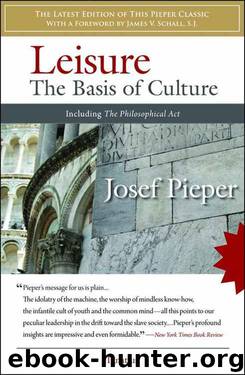
Author:Pieper, Josef [Pieper, Josef]
Language: eng
Format: epub, azw3
Tags: Spiritual & Religion
ISBN: 9781681492919
Publisher: Ignatius Press
Published: 2015-08-06T16:00:00+00:00
II
To philosophize, then, is to take a step beyond the everyday world of work.
Now the meaning of a step is best defined in relation to its goal, to the “whither” rather than to the “whence”. Where does philosophizing carry us? Obviously, in going beyond the world of work, it crosses a frontier: what sort of a world lies beyond? And how are the two worlds related, the world into which the act of philosophizing carries us, and the world which this same act transcends? Could it be said that the former is the “essential” world, and the world of work the inessential; is it the “whole” as opposed to the part; or is it reality as contrasted with appearance?
However these questions may be answered in detail, one thing is clear: both worlds, the world of work and the realm into which the act of philosophizing carries us—both belong to the world of man which is clearly, therefore, a many-storied structure.
Our next question, then, is: What kind of a world is man’s world?—a question which patently cannot be answered without reference to the nature of man. And in order to achieve some degree of clarity, we must begin from the beginning and start from the bottom.
Every living thing lives in a world, in “its” world, and “has” a world in which it lives. To live means to be “in” the world. Though a stone, you may say, is surely “in” the world? Everything there “is”, is “in” the world, surely? But let us stick to the stone, for the moment, lifeless, lying about with other things, next to other things and surely “in” the world. “In”, “next to”, “with”, all prepositions, words indicating a relation: though the stone is not really related to the world “in” which it is, nor to the things “next to” which it lies, nor to those “with” which it is in the world. A relationship in the proper sense of the word, is a link established from inside to something external; relations can only exist where there is an “inside”, where there is that dynamic center from which all activity springs and to which all that is received and all that is undergone can be collectively referred. In this qualitative sense (one cannot, of course, speak of the “inside” of a stone—one can only speak of the “inside” of a stone with reference to the disposal of its parts), the “inside” is the power by virtue of which a relation to something external is possible; inwardness is the capacity to establish relations and to communicate. And what of “world”? Well, world means the same thing as a range of relations. Only a being capable of having relations, only a being of whom “inner” as well as “outer” may be predicated—and this in its turn means a living being—has a world. Only a living being exists within a range of relationships.
There is a fundamental difference between relations thus conceived and the relation which results from the proximity
Download
This site does not store any files on its server. We only index and link to content provided by other sites. Please contact the content providers to delete copyright contents if any and email us, we'll remove relevant links or contents immediately.
| Anthropology | Archaeology |
| Philosophy | Politics & Government |
| Social Sciences | Sociology |
| Women's Studies |
Cecilia; Or, Memoirs of an Heiress — Volume 1 by Fanny Burney(32562)
The Great Music City by Andrea Baker(32023)
Cecilia; Or, Memoirs of an Heiress — Volume 2 by Fanny Burney(31959)
Cecilia; Or, Memoirs of an Heiress — Volume 3 by Fanny Burney(31945)
We're Going to Need More Wine by Gabrielle Union(19054)
All the Missing Girls by Megan Miranda(16052)
Pimp by Iceberg Slim(14522)
For the Love of Europe by Rick Steves(14174)
Bombshells: Glamour Girls of a Lifetime by Sullivan Steve(14081)
Norse Mythology by Gaiman Neil(13379)
Talking to Strangers by Malcolm Gladwell(13376)
Fifty Shades Freed by E L James(13247)
Mindhunter: Inside the FBI's Elite Serial Crime Unit by John E. Douglas & Mark Olshaker(9350)
Crazy Rich Asians by Kevin Kwan(9297)
The Lost Art of Listening by Michael P. Nichols(7509)
Enlightenment Now: The Case for Reason, Science, Humanism, and Progress by Steven Pinker(7316)
The Four Agreements by Don Miguel Ruiz(6770)
Bad Blood by John Carreyrou(6626)
Weapons of Math Destruction by Cathy O'Neil(6285)
